 AuthorPing
Reader guide
Why Is Harry Potter So Popular?
 By James Fleming, founder of AuthorPingPublished Updated
Harry Potter is so popular because it starts with a premise anyone can grasp, a lonely boy who finds out he belongs somewhere better, then sets it in a magical world that sits close to our own and lets the story grow older alongside its readers. The scale is hard to match. According to Rowling's own FAQ, the seven books have sold over 600 million copies in 85 languages, and on AuthorPing's catalogue Harry Potter and the Philosopher's Stone is the second most-read of 84,822 books.
That's the short version. The longer one is more interesting, because the series succeeded for several separate reasons that happened to arrive at once.
Why does the premise of Harry Potter work so well?
The blurb for Harry Potter and the Philosopher's Stone sells the whole idea in a few lines. Harry lives in a tiny room under the stairs, hasn't had a birthday party in eleven years and is stuck with relatives who treat him as a nuisance. Then a letter arrives by owl and invites him somewhere else entirely.
It's an old wish, the hope of being rescued from an ordinary, miserable life by news that you're special, and it works on readers of any age. Children's book professionals were already picking this apart in a 1999 discussion on CCBC-Net. Jonathan Hunt said Rowling blended low comic fantasy with the trappings of high fantasy, while Connie Rockman pointed to a fantasy world that sits close to reality.
That second point does a lot of the work. Hogwarts has lessons, homework, exams, a sports rivalry and unfair teachers, so readers recognise the shape of every school year even when the details involve dragons. You don't need a map or a glossary to get started, which is more than many fantasy series can say.
Did the series grow up with its readers?
It did, and the publishing schedule made that possible. Rowling's FAQ gives the publication years as 1997 for the first book, then 1998, 1999, 2000, 2003, 2005 and 2007. Someone who picked up the first book at eleven was in their twenties by the time the last one came out.
The blurbs show the story changing with them. Harry Potter and the Prisoner of Azkaban centres on an escaped prisoner and a possible traitor at school. Harry Potter and the Goblet of Fire describes Harry as midway through "his coming of age", and Harry Potter and the Half-Blood Prince talks about a war that is going badly, losses already suffered and teenagers who "flirt and fight and fall in love". The books stay recognisably the same series while the stakes rise each year.
The gaps helped build appetite, too. Readers waited three years between Harry Potter and the Goblet of Fire and Harry Potter and the Order of the Phoenix, which is the kind of gap that sends people back to reread the first four books, possibly more than once. As someone who built an app because I hate waiting blind for the next book in a series, I have some sympathy for everyone who spent those years refreshing news pages.
The books also got much longer. San Francisco Chronicle critic David Kipen, a dissenting voice on Harry Potter and the Half-Blood Prince, suggested readers who bore easily might feel done in by the 600-plus page novel. That's a fair warning, but it's also the kind of complaint a series only attracts once its fans are queuing for every one of those pages.
It mattered that adults were reading as well. Wikipedia notes that the books attracted a wide adult audience as well as younger readers, which turned the series into something families shared rather than something parents simply bought.
Why were Harry Potter releases such huge events?
By the later books, each release had become a record-breaking event. Scholastic says 6.9 million copies of Harry Potter and the Half-Blood Prince sold in the US in the first 24 hours, breaking all publishing records. In the UK, Bloomsbury said just over 2 million copies sold on the first day, a record there as well.
Fox News reported that Lisa Holton, president of Scholastic Children's Books, called the sales "a cause for celebration", which is a calm way to describe the biggest day in publishing history. The print runs tell the same story. Scholastic lists US initial print runs of 6.8 million and 12 million for Harry Potter and the Order of the Phoenix and Harry Potter and the Deathly Hallows.
Wikipedia says the last four books all set records as the fastest-selling books in history, and Scholastic says every Harry Potter book has been a number 1 New York Times and USA Today bestseller. Once a release becomes something the whole world reads in the same weekend, it starts to sell itself: avoiding spoilers becomes one more reason to read fast.
Did parents and schools help Harry Potter succeed?
They did, because the series was something adults wanted children to read and something children wanted to read anyway. That combination is rarer than it sounds. In Scholastic's 2006 Kids and Family Reading Report, 76% of parents said reading Harry Potter had helped their child do better in school.
Booksellers still use the series as their yardstick. In a Daily Telegraph piece by Anita Singh, Waterstones head James Daunt said BookTok was bringing young people into bookshops in numbers not seen since the Harry Potter years. He was talking about BookTok in general rather than claiming Harry Potter itself went viral there, but the comparison says plenty. Daunt added that the Harry Potter generation "stepped booksellers up" and stepped book sales up as well.
How much did the films matter?
The films gave the story a second life on screen. The original seven books were adapted into an eight-part film series by Warner Bros, which gave people who might never open a long novel another way into the world, and gave readers a reason to revisit the books.
The screen story isn't finished either. Wikipedia says an HBO television series based on the books is in production, so another generation is about to meet these characters for the first time.
What do critics say about Harry Potter's popularity?
Critics have never been unanimous. Wikipedia says critics and literary scholars gave the books mixed reviews, and some of the sharpest comments are also the most revealing. In that same 1999 CCBC-Net discussion, Roger Sutton said the frenetic pace, arbitrary magic and banal dialogue he disliked might actually add to the popularity.
The reading that fits best with what these early commentators said is that the series wins on pace, familiarity and momentum rather than on literary polish. A story that moves quickly through a world that feels like an exaggerated version of school is easy to pick up and hard to put down, and that matters more to most readers than whether every line of dialogue is elegant.
What do the numbers show?
The sales figures are the headline. Wikipedia calls the books the best-selling book series in history, and Scholastic says more than 230 million copies have sold in the US alone. Rowling's FAQ adds that the audiobooks have been listened to for two billion hours.
Goodreads shows how warmly readers rate them. The Goodreads series page lists Harry Potter and the Philosopher's Stone at a 4.47 average from 11,898,115 ratings, and on the page for the US edition, 64% of ratings are 5 stars. Few books get nearly twelve million ratings at all, let alone keep an average that high.
Our own figures come from Hardcover, a reading site much smaller than Goodreads or StoryGraph. There, Harry Potter and the Philosopher's Stone has 16,956 readers, which makes it number 2 of the 84,822 books on our catalogue, so it sits right at the top of the list. That number is a lot for a site of Hardcover's size.
AuthorPing's own daily count shows that book's Hardcover readership growing by about 2% a week, measured over 29 days. For a book first published nearly three decades ago, that's a sign new readers are still arriving every week, not just old fans logging a reread.
The rest of the series holds on to its audience well. Harry Potter and the Deathly Hallows has 11,520 readers on Hardcover, about two-thirds of the first book's count, so most people who start seem to finish. Oddly, Harry Potter and the Half-Blood Prince has 11,500, twenty fewer than the finale, which suggests a handful of readers either skipped straight to the end or simply forgot to log book six.
Where should I start with Harry Potter?
Start with Harry Potter and the Philosopher's Stone and read the seven books in publication order, since each one follows a single school year and builds on the last. If you're in the US, the first book has a different title there, because Scholastic published it the next year under its own name for American readers. The full Harry Potter reading order is on our series page if you want every book listed in one place.
Will there be another Harry Potter book?
There's no eighth main novel on our calendar, and Rowling's FAQ lists the seven books as the series. The next new thing on the way is the HBO television series, which is in production, so the story is heading back to screens rather than to new pages for now.
If anything does change, you shouldn't have to find out months later. AuthorPing lets you know when a series or author you love has a new book coming out and keeps a countdown to every release, and it's free on iPhone and Android.
About J.K. Rowling
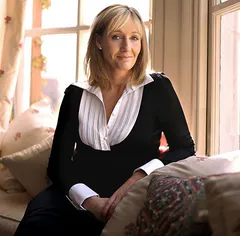
Joanne Rowling was born on 31st July 1965 at Yate General Hospital near Bristol, and grew up in Gloucestershire in England and in Chepstow, Gwent, in south-east Wales. Every Harry Potter release date
Questions readers ask
Why is Harry Potter so popular?
It pairs a simple, relatable premise, a neglected boy who discovers he belongs in a magical world, with a setting close to everyday school life. The books grew older and darker with their readers, and each later release became a global, record-breaking event.
How many Harry Potter books have been sold?
J.K. Rowling's site and Scholastic both put sales at over 600 million copies worldwide, in 85 languages. Scholastic says more than 230 million of those were sold in the US alone.
What order should I read the Harry Potter books in?
Read them in publication order, starting with Harry Potter and the Philosopher's Stone and finishing with Harry Potter and the Deathly Hallows. The full Harry Potter reading order is on our series page.
Is there going to be an eighth Harry Potter book?
There is no eighth main Harry Potter novel on our calendar. The next new project is an HBO television series based on the books, which is in production.
Is Harry Potter only for children?
No. The books attracted a wide adult audience from early on, and the later ones deal with war, loss and growing up, so many adults read them for the first time or reread them.
Sources
James is the founder of AuthorPing. He's a lifelong reader and writer, and his goal is to help millions of readers around the world keep up with their favourite authors and series. More about AuthorPing
 Scan with your phone